


Read the whole worldof Albion Online.
A live Albion Online world map, damage meters, a kill feed, guild and player intel, a crafting calculator and a market ledger — pooled across the players you choose, from a passive desktop agent that only watches what you already see.
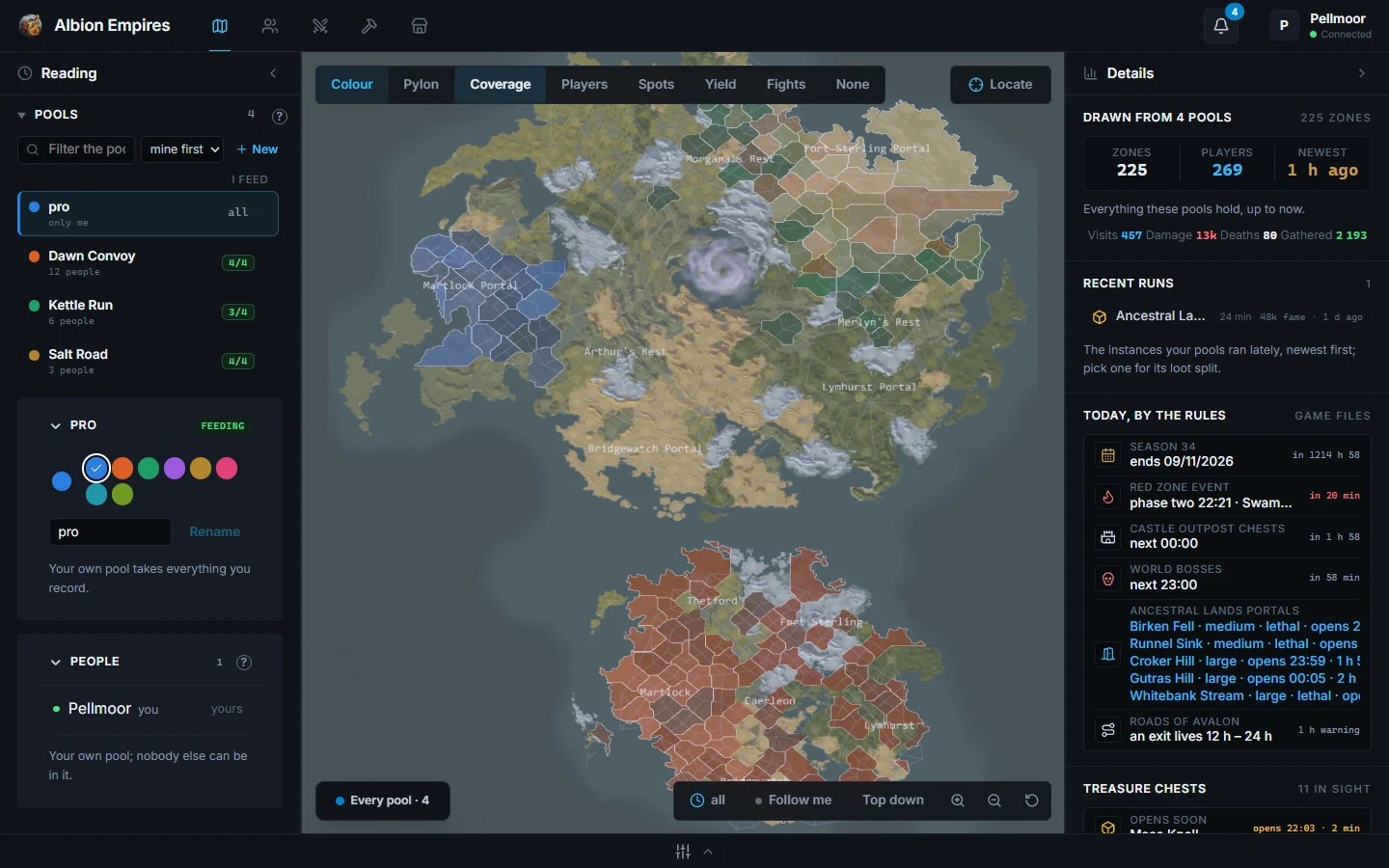
Every screen on this page is the app itself, taken on a test world — the names are invented.
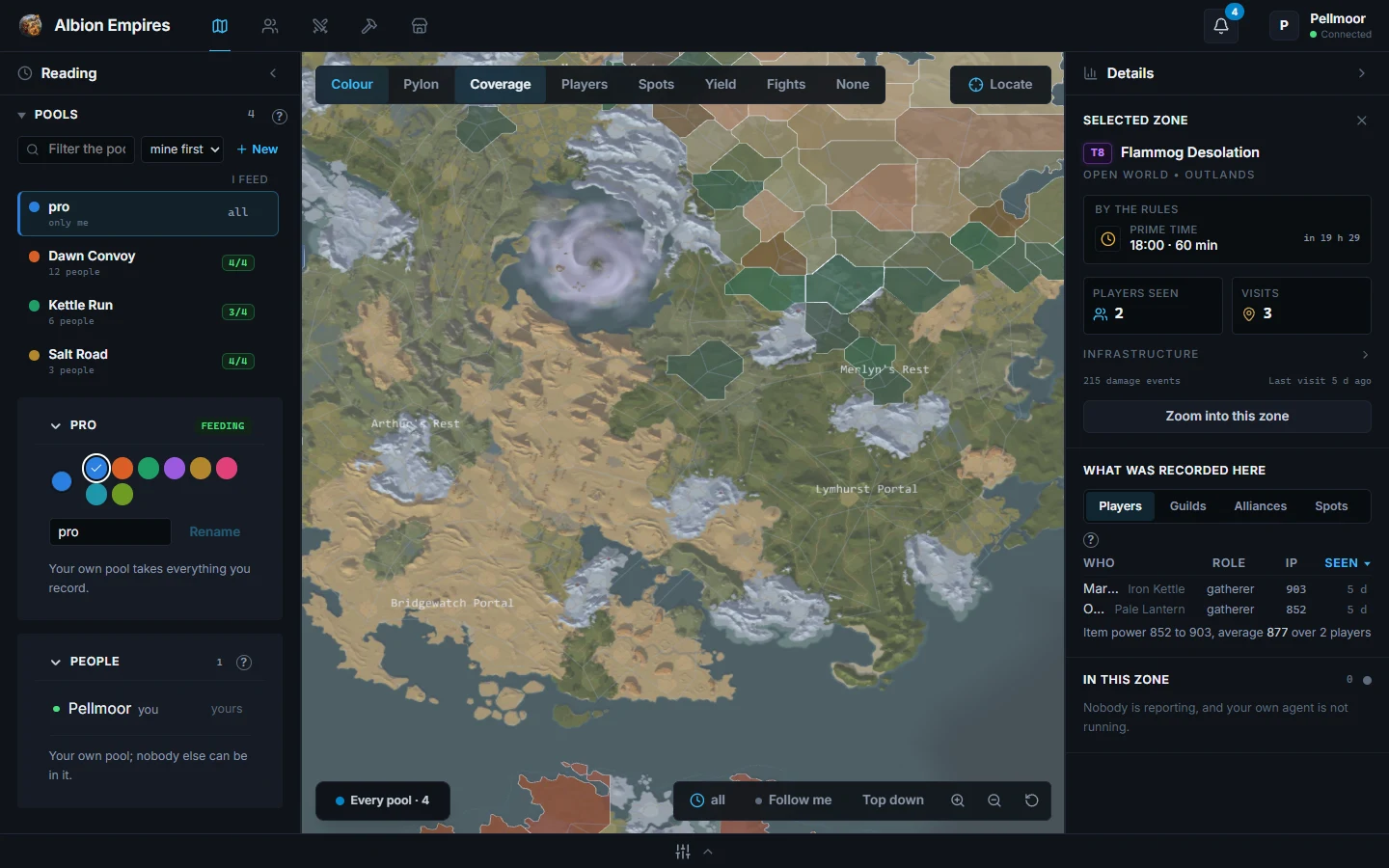
An Albion Online map that shows coverage, freshness and danger in one colour.
The map is a graph of the whole world. Every zone is painted by whichever of your pools recorded it, shaded from dark to bright by the metric — so hue says whose and lightness says how much, at a glance.
- Freshness & coverage — how long since anyone in your pools set foot in a zone, and where the gaps are.
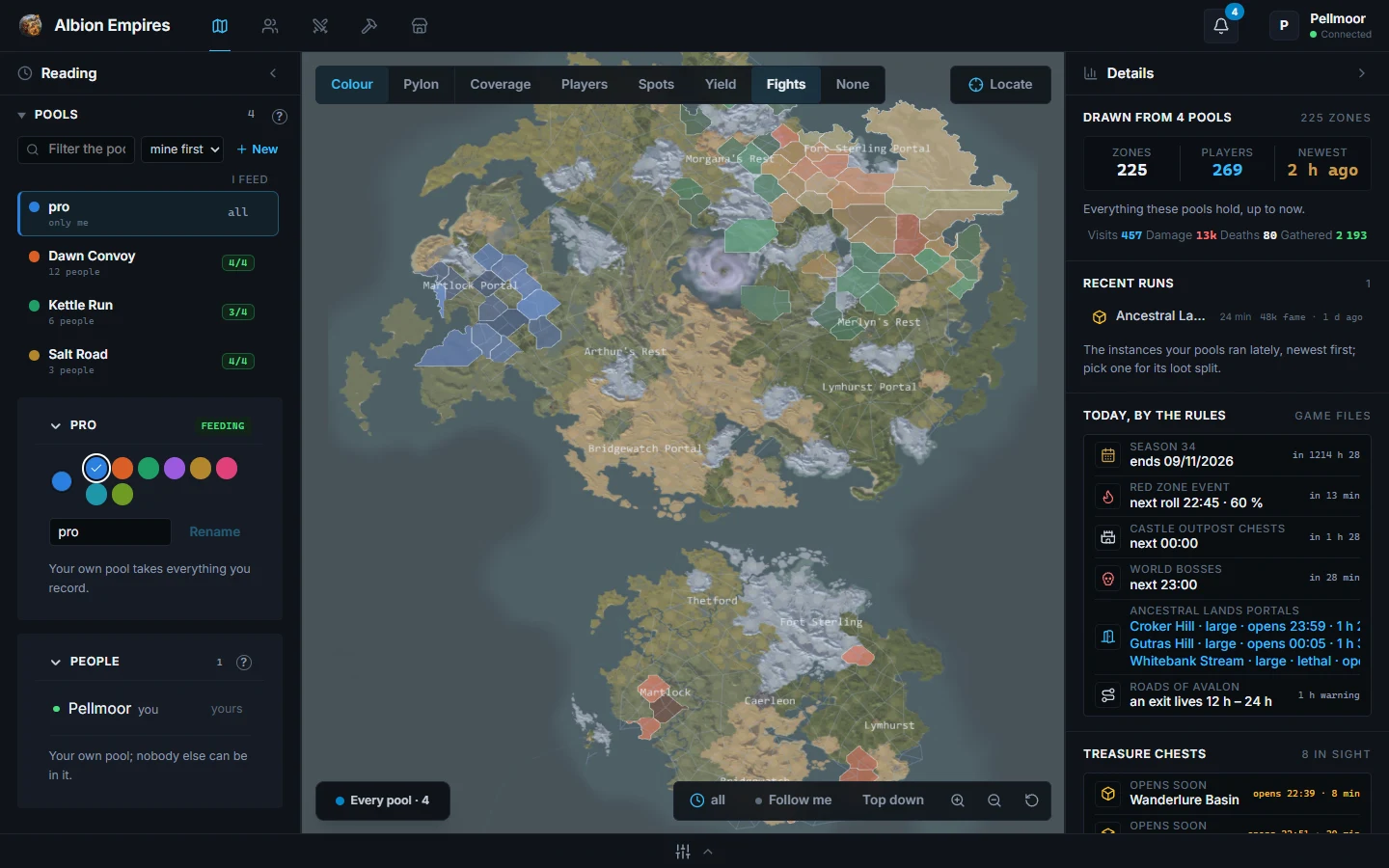
- Danger — kills and deaths from the public API, so the map is useful before you have a single agent.
- Wind time back — a rail measured in the window you set; ask what you knew last Tuesday.
- Yield — what your pools gathered in each zone, by material, tier and enchantment.
- Runs — a dungeon, a Mists trip or an Ancestral Lands dive keeps its fame, its chests, who picked up what, and the loot split it owes.
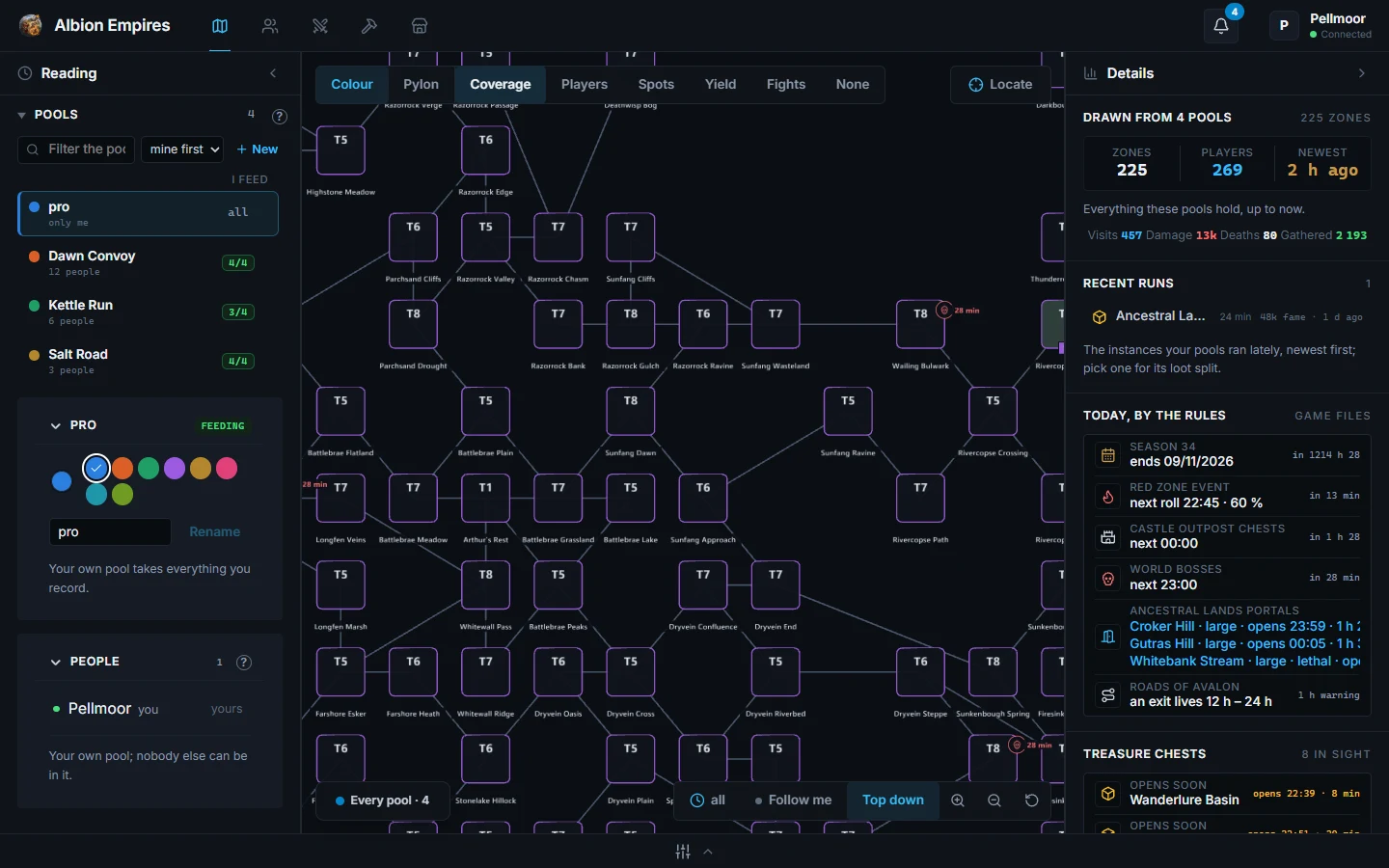
- Box mode — the world as a war-room board, one labelled card per zone, framed in its danger colour.
- Retrace & follow — draw one player's path through the zones, or keep the camera on where they were last seen.
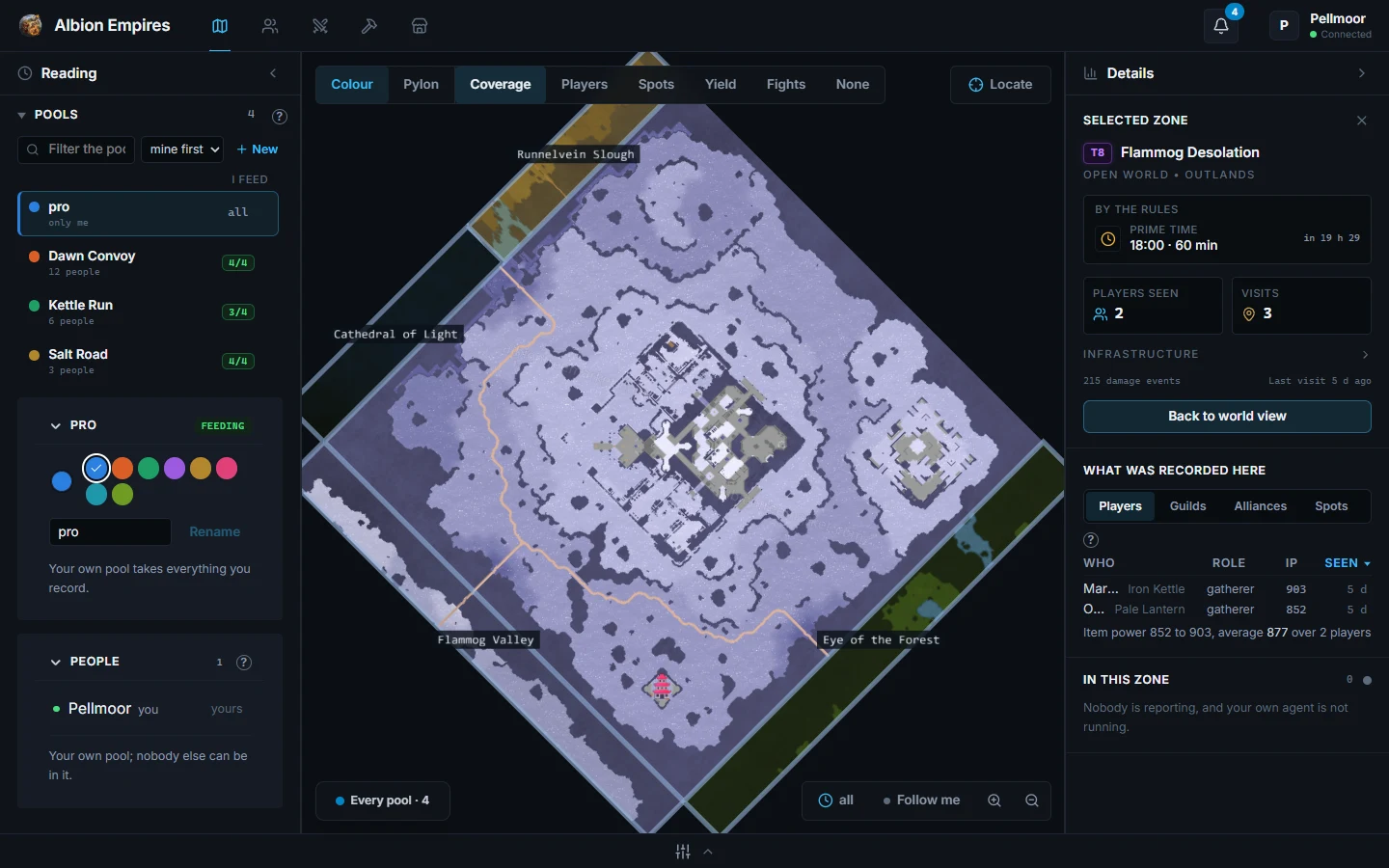
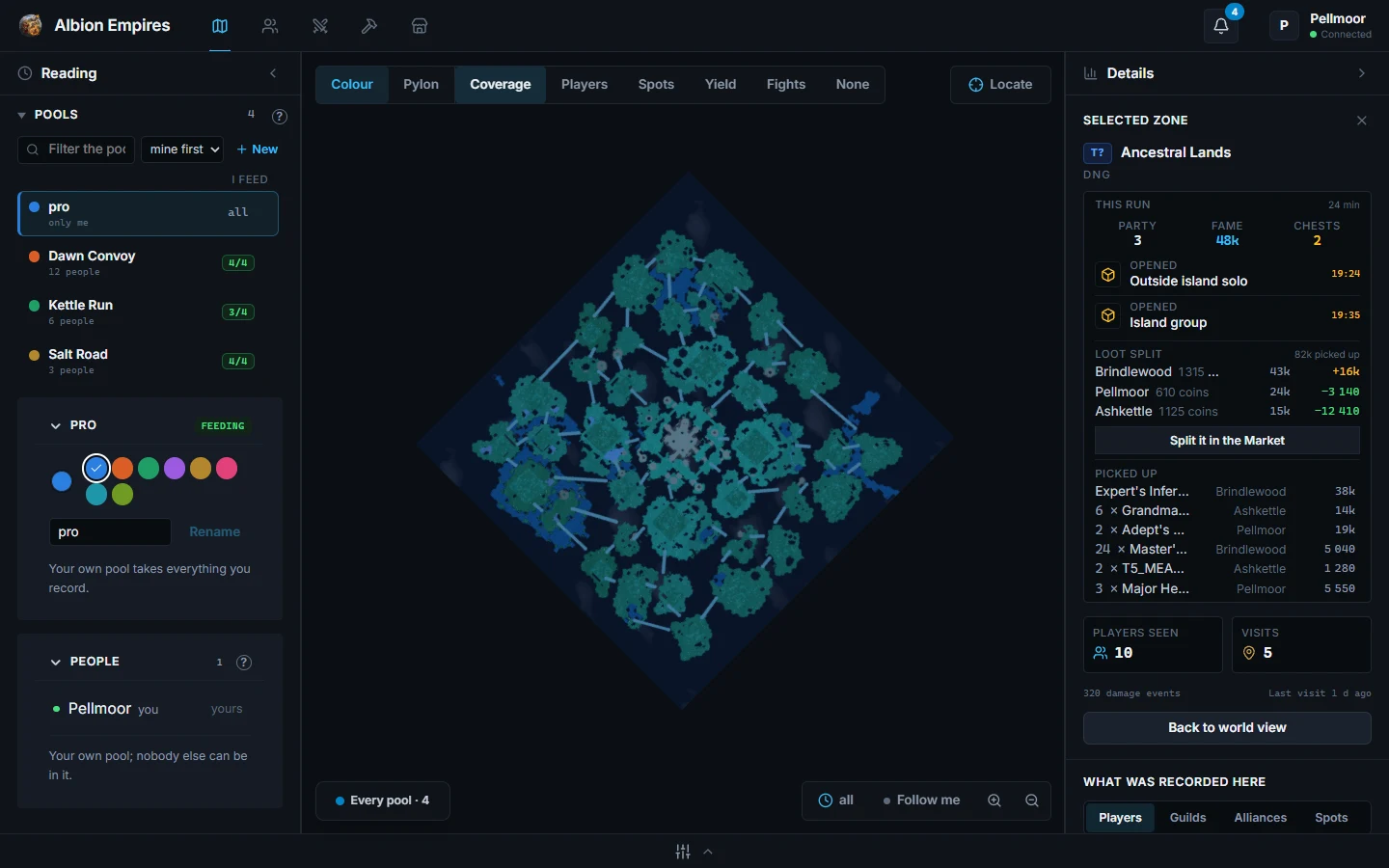
Every module, from the wire to the ledger.
Five halls, one question each: where have people been, who are they, what happened, what does a craft cost, what did a sale fetch.
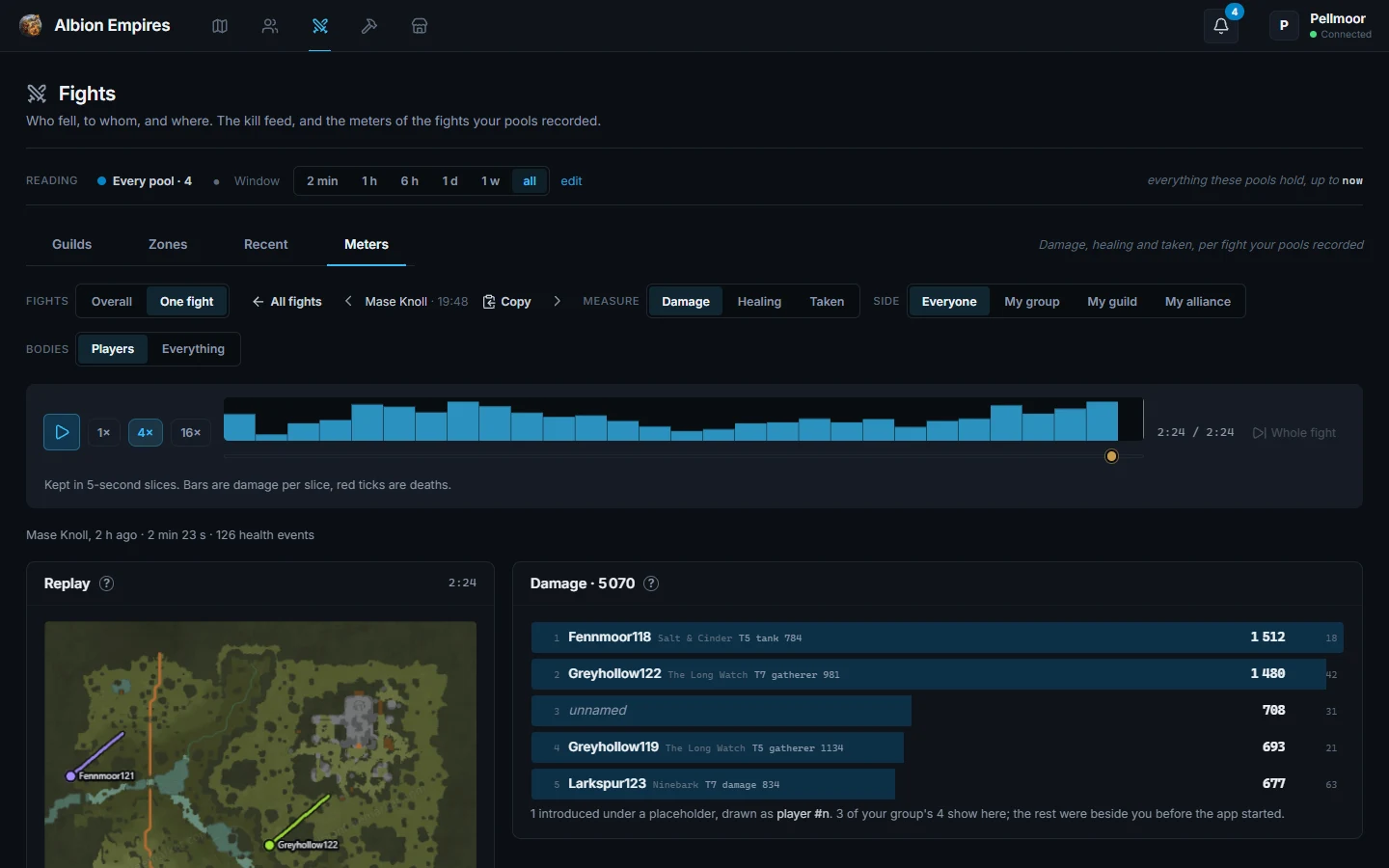
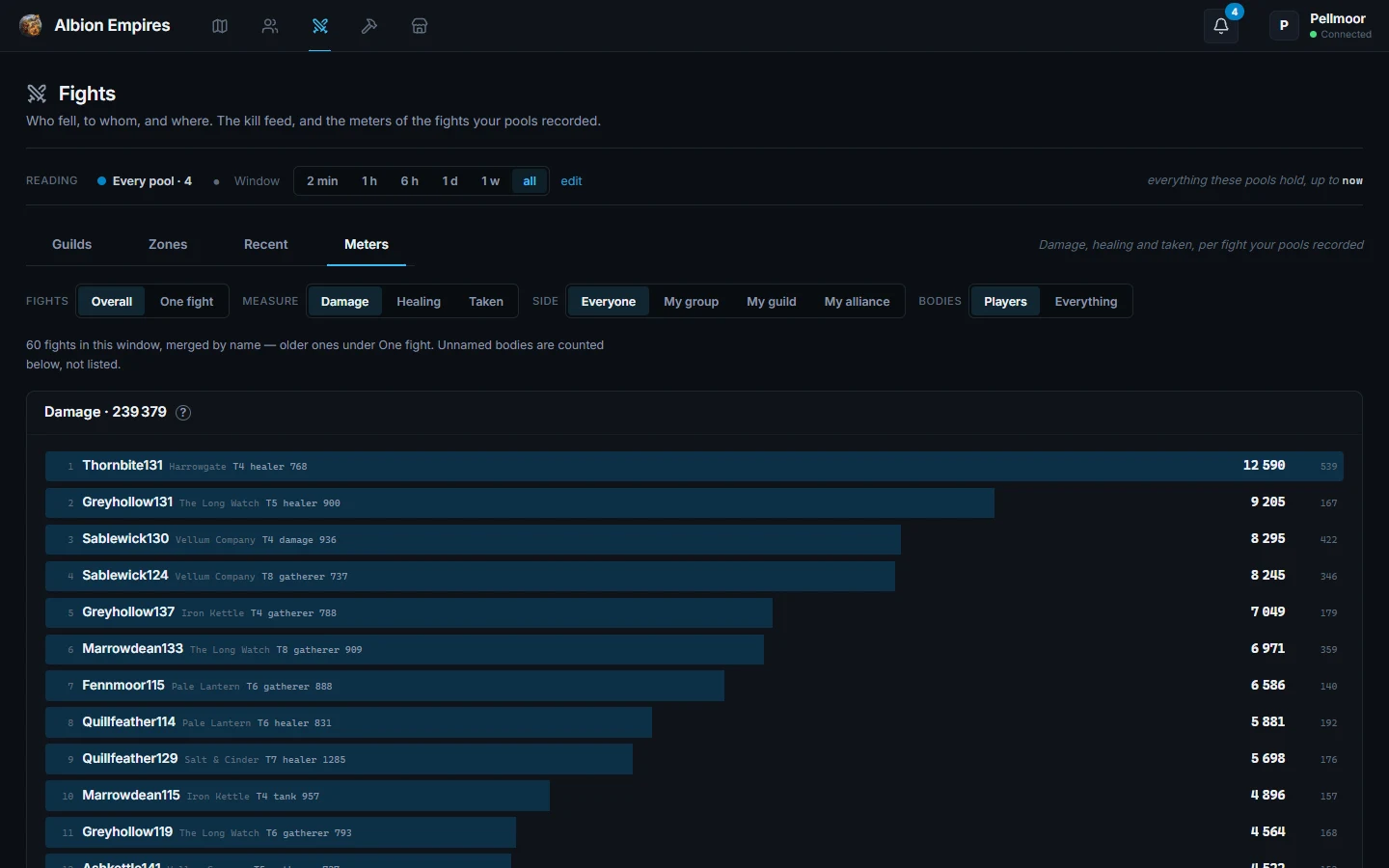
A damage meter and a kill feed for every fight.
The killboard the game shows everyone, and a Recount-style damage meter for every fight your pools recorded — replayable second by second on the zone it happened in.
- Per-fight meters — damage, healing and taken, ranked by body, with a breakdown by opponent and by ability.
- Replay — a timeline with deaths, and the recorder's own path drawn on the zone.
- Sides — filter to your group, your guild or your alliance, decided fight by fight.
- Biggest blow, overheal, and a Copy button — the hit that hurt most, the healing that went past full, and a fight written as a short Discord message.
- Honest about masks — a name the game withheld is shown without one; a placeholder never becomes a name.
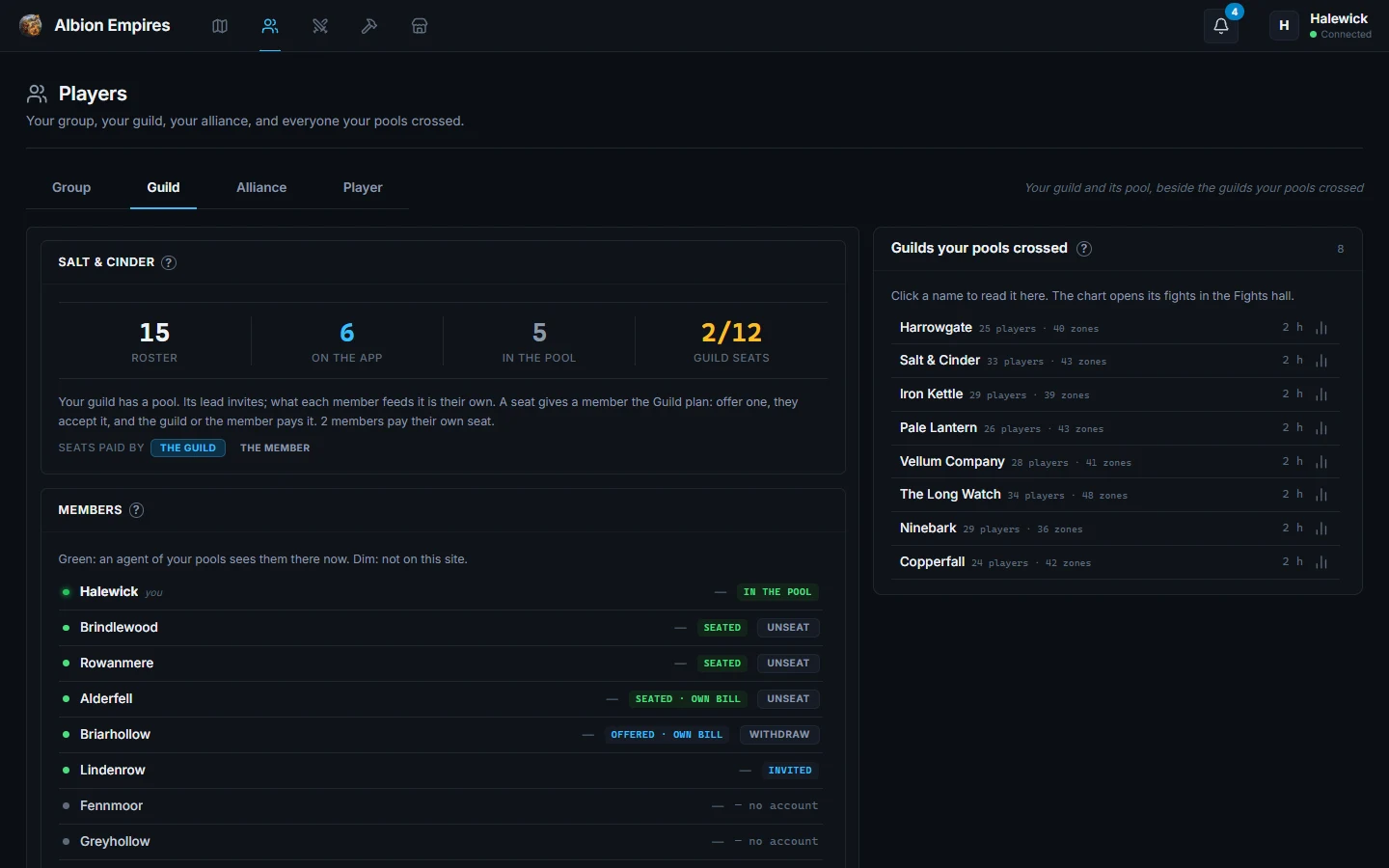
Guild and player intel: who holds the place, and where they stand.
Your own party as the game hands it to you, your guild's roster from the public API, every faction your pools have crossed — and a sheet for any player, opened from any name in the app.
- Player sheet — fame, ratio, PvE and gathering fame, the last kills and deaths with the gear worn, read from the public API on the spot, plus everything your pools recorded of them.
- Guild roster — as the game knows it, marked with who has an account here, who has the app paired, who is in the pool and who holds a seat.
- Crossed factions — read the dossier of any guild through the records your pools actually hold.
- Founder-gated pools — only a guild's founder can present records in the guild's name.
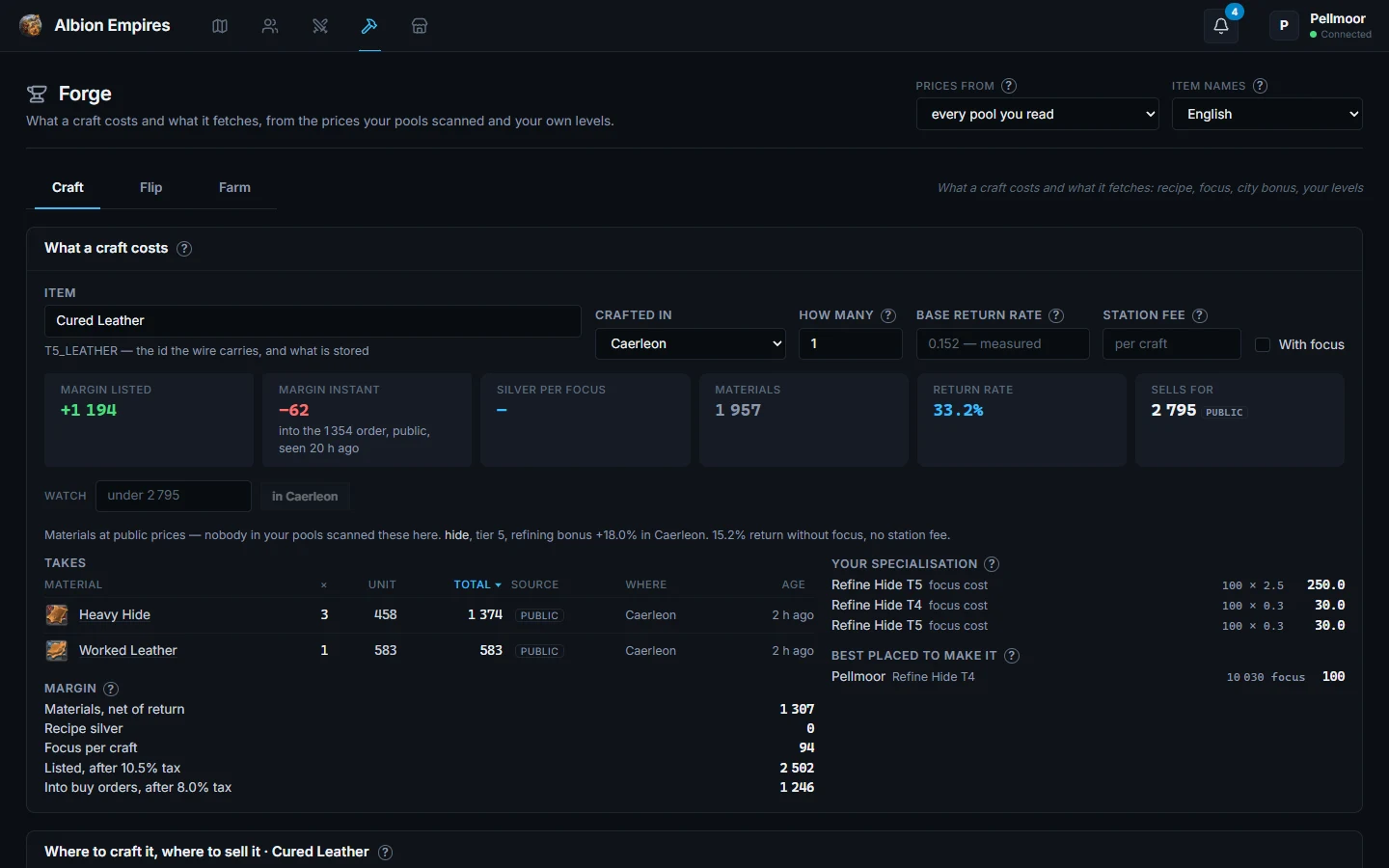
A crafting calculator with live prices: what a craft costs, and where to sell it.
The recipe, the focus cost, the city bonus and the marketplace tax come from the client; your specialisation and the prices come off the wire — your pools' scans, and public prices where nobody scanned.
- Return rate & focus — the margin flips on the focus toggle, the way refining actually works.
- Where to craft & sell — every market at once, with the best pairing between them.
- Best crafts — cost every recipe of a category, tier or name in one city, ranked by margin, ROI or silver-per-focus.
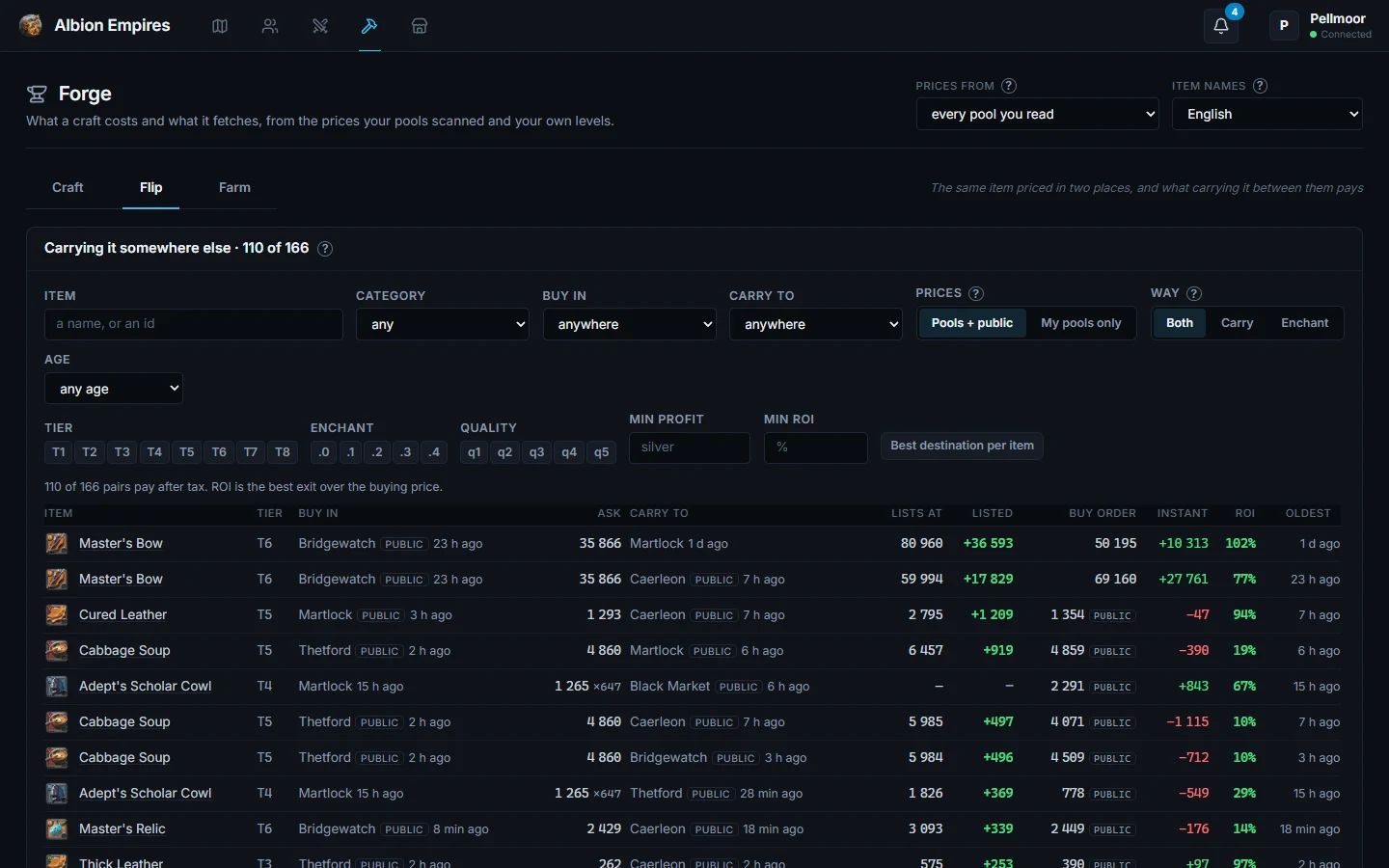
- Flips — carry an item between two markets or the Black Market, or enchant it — the plain item plus its runes, souls and relics against the enchanted one — sorted and filtered every way, after tax.
- Watch a price — name an item and a price, and be told when a pool of yours scans it under.
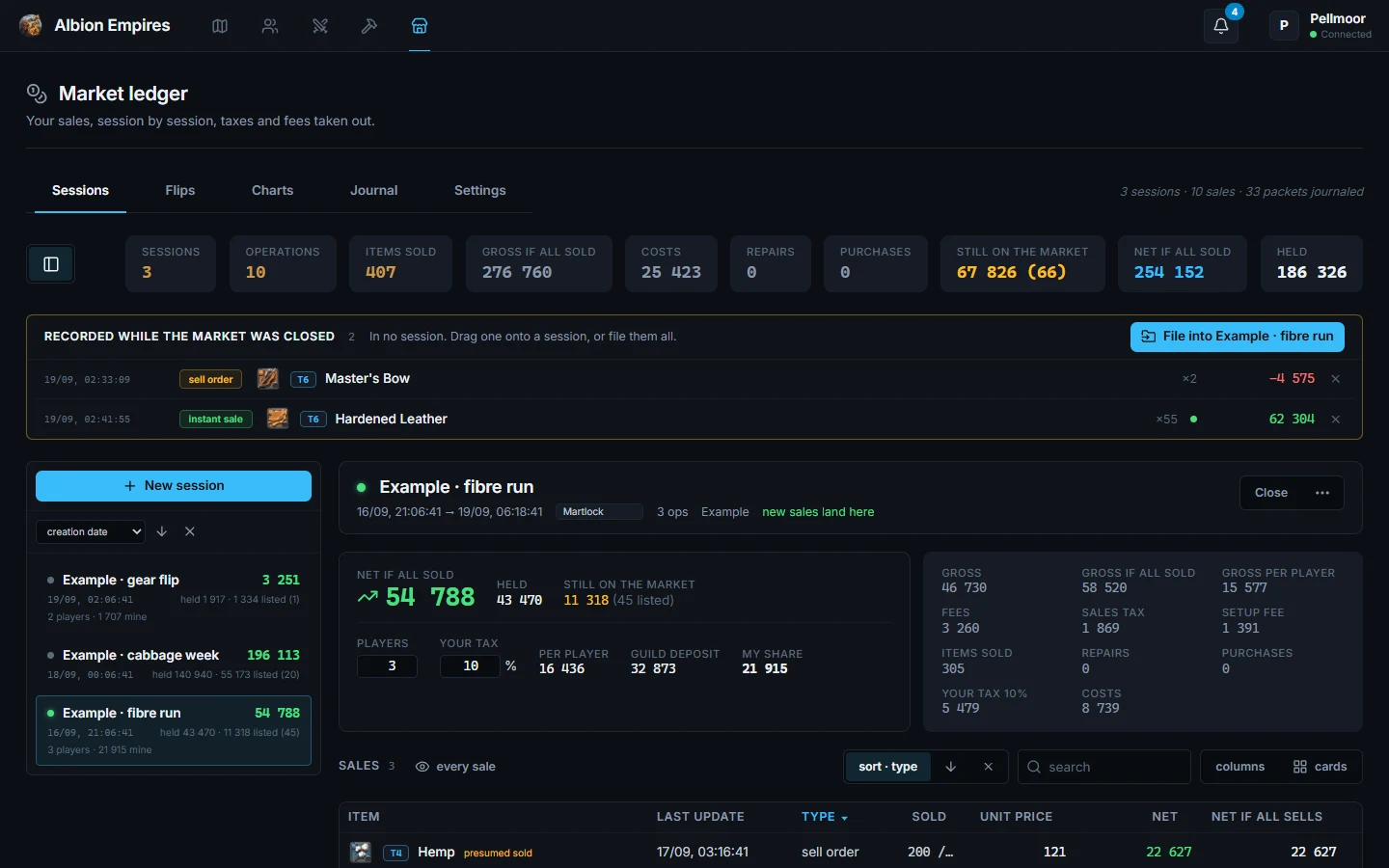
An auction-house ledger: your sales, split and settled.
The accountant, moved in. It reads your own auction-house activity off the wire and rebuilds a ledger — taxes, fees and repairs taken out. This is the one thing that is never pooled: a sale is yours alone.
- Sessions — one per farming run or per week, with a loot split across the players you name.
- Presumed-sold, then confirmed — reconciled against your own orders, and settled by the game's own mail once you open it.
- Purchases and flips — instant buys and buy orders recorded, and every resale beside the purchase it consumed.
- Copy for Discord — a message template filled from a session's own figures.
- Charts — by item, type, tier, quality, buyer, seller and market, over any range.
Record everything, share by choice.
You are your own pool from the moment you sign up — a pool of one that records everything you see. It grows only by invitation, and shrinks by anyone's decision.
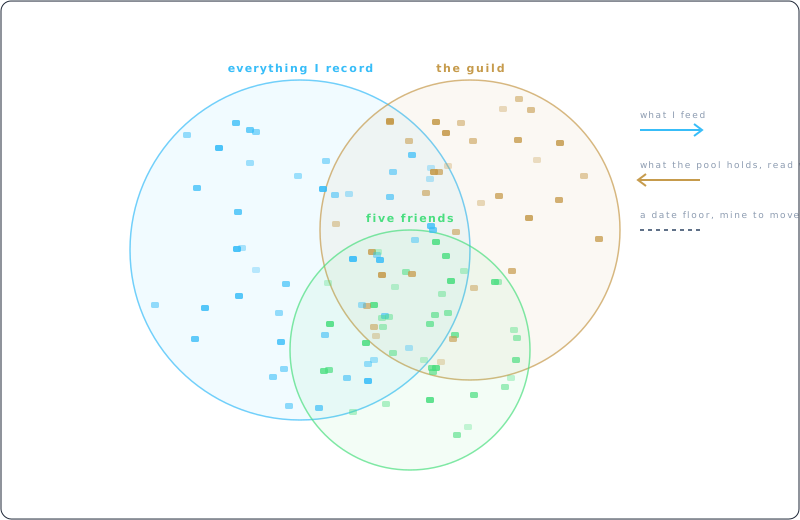
You choose who sees what.
- Sharing starts at zero — nothing leaves your pool of one until you say so, per kind and per entity.
- The lead invites, the guest accepts — nobody is enrolled without their yes, and nobody else is asked.
- What you feed is yours — which kinds, which guilds, alliances and players, from which date; what a pool holds, every member reads whole.
- No raw export — no one drains a pool in a single request; reads are logged, not only writes.
- Merge, don't sum — a player watched by two pools is one player, never two.
How it works.
The agent listens
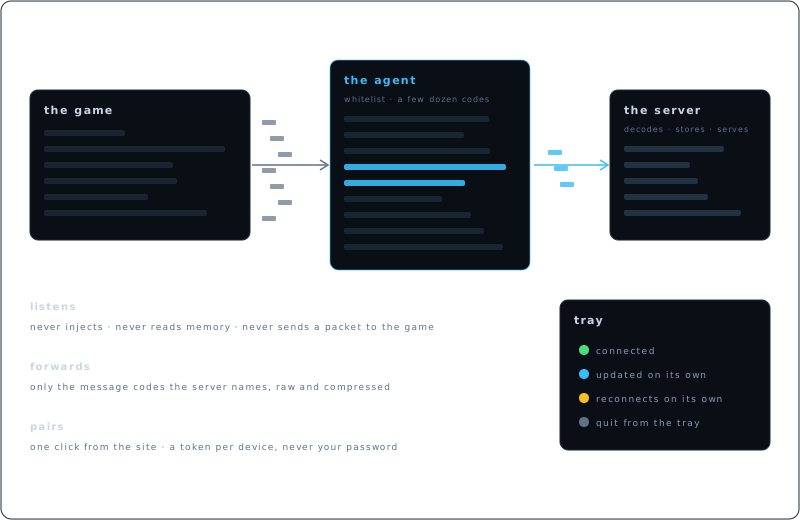
A small Windows tray app passively sniffs the Photon traffic your own game already sends. It never reads memory, never injects, and never sends a packet to the game.
The server decodes
The agent forwards only the message codes the server whitelists, raw and compressed. The server decodes them, so a game patch is a deployment, not a forced update of every agent.
The pool reads
Your records land in the pools you feed, and the map is the union of the pools you read. One click from the site pairs a device; a token per machine, never your password.
Small on purpose, and honest by design.
It holds no business logic — it identifies a few bytes and forwards what the whitelist names. That split is what keeps it small enough to rarely face SmartScreen, and what makes the whole project defensible.
- Tray only — connected, updating and reconnecting on its own; quit from its menu.
- Self-updating — the server pushes a new build over the socket; you never reinstall.
- Works app-first or game-first — it picks your character up at the next zone change either way.
Everything the wire already carries.
Read from data the game sends anyway — nothing extra captured, nothing stored that only answers "where is X this second".
ZvZ alerts
A live pulse on any zone where a fight is happening and one of your pools is watching — counted by heads, not by a stale record.
Territories & timers
Who holds each zone, its castle and chest hour, prime time, faction outposts and hideouts — read off the game's own world map.
Minimap marks
Dragon attacks, chests, rich resources with their unlock hour, power cores and tracks — whatever the zone's minimap listed at the join.
Almanac
Today by the rules: the season, the red-zone event, castle reveals, world bosses, portal waves and road lifetimes — from the client's own files.
Islands & roads
Your island's objects, drawn on its own template with what the agent heard; a road's doors where they stand, and which you crossed.
Mists & Ancestral Lands maps
A Mists instance is named at the second fishing spot and drawn on its master, turned the way it was; the Ancestral Lands on theirs — both painted with the game's own palette.
The capture is passive, always.
Never touches the game
The install is read-only — not a file, not a byte. No memory is read, nothing is injected, and no packet is ever sent to the game servers.
Only what's whitelisted
The agent forwards a few dozen message codes the server names, raw. It decodes nothing itself and stores no game files.
Nothing personal leaks
Your data lives in your pools. No raw export, no bulk read, and a zone that hides a name keeps it hidden here too.
Three plans.
Pick how much of the town you need. What you record and what you share is yours on every plan.
Monthly, or by the year for the price of ten months — on every plan and on every seat.
A demo of the whole town, one day at a time.
- 1 pool besides your own; pools of 5
- Maps and Fights, one day back
- Sightings and fights kept one day
- Forge on public prices
- Market ledger, complete and never limited
- No Players hall, no pool alerts
or €49.90 a year
The whole town for one player: every hall, all your history.
- 10 pools besides your own; pools of 30
- Everything read back, sightings kept 30 days, fights 90
- Players — party, guild, alliance
- Alerts from your pools
- Your pools' own prices in the Forge, flips included
- Market ledger, complete
or €99.90 a year
Everything in Pro for the lead, a pool for the whole guild, and seats for the members you choose.
+€2.99 per seat a month, €29.90 a year · a seat is the Guild plan for one member, paid by the guild or by the member
- A guild pool that takes the whole roster
- Seats: offer one to a member, they accept, their own plan stops — on the guild's bill or their own
- 30 pools besides your own; pools of 100
- Sightings kept the whole season — 90 days
- Guild dossier and pool alerts
Prices in euro, VAT included. A member without a seat keeps their own plan; the guild pool is the lead's. Three players pay less as three Pros; from four, a guild with seats costs less.
Before you install.
Is it safe to use with Albion Online?
The agent only listens to network traffic your own client already sends. It never reads game memory, never injects, and never sends anything to the game servers, and the install itself is never written to. That passivity is the whole point — it is what makes the project defensible.
What exactly does the agent capture?
Only the message codes the server whitelists — a few dozen — forwarded raw and compressed. The server does all the decoding. Because the whitelist lives on the server, a game patch is a deployment there, not a forced reinstall of every agent on every machine.
Who can see what I record?
Everything starts in a pool of one, which is yours. Nothing is shared until you say so — per person and per kind — and you can narrow it again at any time, backwards as well as forwards. There is no raw export and no endpoint that hands back a pool in bulk.
Does it work if I start the app after the game?
Yes. If the game is already running, the agent picks your character up at the next zone change and resumes from your last known zone until then. The site tells you plainly which of those states it is in.
What does it cost?
Nothing during the beta: every account is Pro, free. At launch there is a free Discovery plan, Pro at €4.99 a month, and a Guild plan at €9.99 a month plus €2.99 per seat — a seat gives one member the Guild plan, and the lead chooses whether the guild or the member pays it. Paid by the year, everything costs ten months. Each account is accepted by hand for now.
Is there a damage meter for Albion Online in it?
Yes. Every fight a pool records gets a Recount-style meter — damage, healing and damage taken per body, broken down by opponent and by ability — with a second-by-second replay on the zone it happened in, and a kill feed beside it.
Is it an interactive map of Albion Online?
Yes — the whole world as one map, every zone coloured by how recently your pools visited it, how dangerous it is, who holds it and what was seen there, with a time rail to wind history back, plus the Mists and the Ancestral Lands drawn on their own maps.
Watch the network.
Read the country.
Your agent records what you see; the map shows what others share with you.